Israeli-American Astronaut Protection Vest Goes on Display at Smithsonian
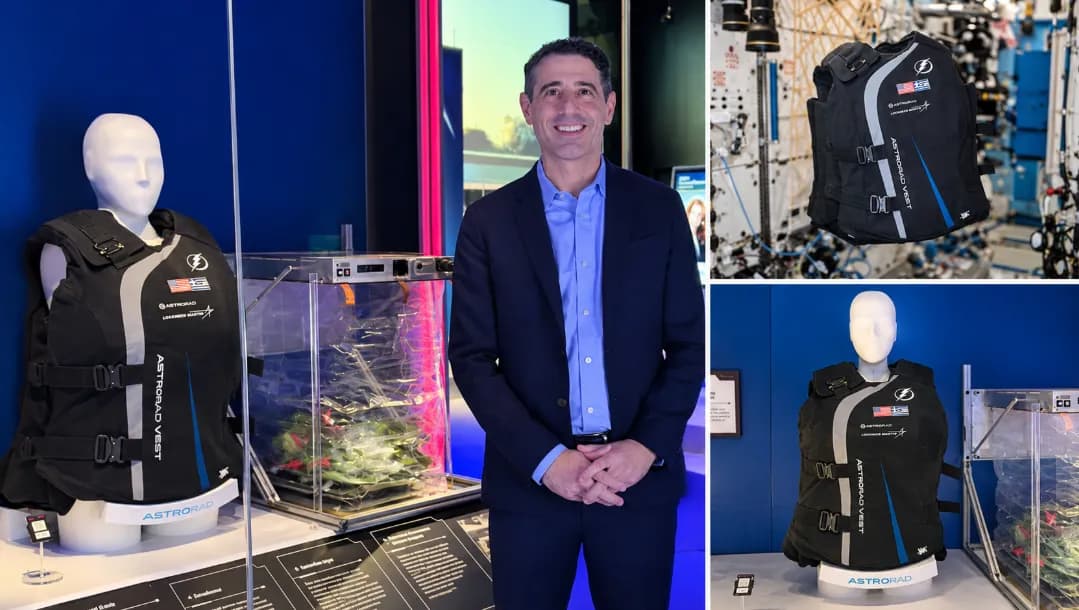
An astronaut radiation-protection vest developed by Israeli-American company StemRad went on display October 30 at the Smithsonian’s National Air and Space Museum in Washington, D.C., bringing a piece of spaceflight research into a public exhibition.
The AstroRad vest is featured in the museum’s At Home in Space gallery. Four female American astronauts and an Israeli private astronaut wore the garment aboard the International Space Station during evaluations involving everyday activities, including work and sleep, according to the company.
Those tests examined a practical question alongside radiation protection: whether astronauts could comfortably wear protective equipment without significantly disrupting their normal tasks. Axiom Space describes the related human-factors research as assessing a wearable device intended to shield sensitive organs and tissues during solar particle events.
AstroRad was developed with Lockheed Martin. StemRad specializes in protective equipment for space exploration, emergency response and defense, and its design aims to concentrate shielding around vulnerable organs while preserving the wearer’s mobility.
The Smithsonian garment is distinct from another AstroRad vest that traveled around the Moon on NASA’s uncrewed Artemis I mission. That second vest is displayed at the Kennedy Space Center Visitor Complex in Florida. The two objects represent different stages of the technology’s evaluation.
A peer-reviewed study published August 12 in Science Advances examined Artemis I measurements from two instrumented models of female torsos, one shielded and one unshielded. Researchers extrapolated measurements taken during passage through the inner Van Allen radiation belt to model major solar particle events.
The modeling predicted an effective radiation-dose reduction of about 60 percent for an event resembling the August 1972 solar storm and nearly 40 percent for one resembling the October 1989 event. These estimates describe modeled storm conditions, not radiation storms encountered during the Artemis I flight.
Museum curator Jennifer Levasseur said the exhibit connects concern about radiation on longer spaceflights with technology demonstrations aboard the space station. StemRad co-founder and chief executive Oren Milstein described the display as recognition of the company’s work and an opportunity to encourage future space researchers.
The exhibition connects an object worn in orbit with the engineering and research behind protective equipment for longer missions. The research evaluates how wearable shielding could reduce particular radiation exposures, while the space-station trials address how astronauts can use the equipment during daily activities.
References
JNS — October 30, 2026.
jns/news/u-s-news/israeli-american-made-space-vest-on-display-at-smithsonian
StemRad announcement via PR Newswire — October 30, 2026.
prnewswire/news-releases/astrorad-vest-worn-by-astronauts-aboard-international-space-station-to-go-on-display-at-smithsonian-national-air-and-space-museum-302925068
Science Advances / Oak Ridge National Laboratory publication record — August 12, 2026.
impact.ornl/en/publications/first-evaluation-of-wearable-radiation-protection-for-human-deep-
Axiom Space — publication date not stated; accessed November 2, 2026.
axiomspace/research/astrorad